
Arrest Warrants in Martin County
For an arrest-warrant question in Martin County, the Sheriff's Office, the County & District Clerk, and the 118th District Court are the three offices to contact. Keep one thing in mind. The agency that serves the papers rarely keeps the court file. That division of labor trips people up all the time. Ask each office directly what it can explain about the case and which details it can share. If the question involves your own situation, a Texas lawyer should review your options before you respond to anything. A broad name search, on its own, cannot settle which court owns the file. The sheriff is still a useful first call. Deputies can often point a service question in the right direction, even though the court that issued the warrant holds the judicial record and controls any later action. A county webpage with no warrant link proves nothing about what process actually exists in Martin County.
Probable Cause Starts a Martin County Arrest-Warrant Record
Every Martin County arrest warrant traces back to the same statutory framework. Texas Code of Criminal Procedure Chapter 15 spells out the requirements: a sworn basis and a magistrate who reviews it and issues the process. The supporting affidavit, complaint, or related record may stay closed to the public even when a case or a warrant itself can be confirmed. That surprises a lot of people. Do not assume the docket will show every detail behind an arrest warrant in Martin County. When you call the office, ask plainly what it can confirm without releasing restricted material. If staff cannot hand over a public copy, ask which rule or exception applies and whether some other case record is open instead. A lawyer can help with anything case-specific. Texas Code of Criminal Procedure Chapter 15 is the official statutory source for how arrest-warrant procedure works.
What a Martin County Arrest Warrant Contains
Martin County publishes no sample arrest-warrant record and no local number format. Treat the fields below as questions worth asking the court, not as a promise that each detail is public or appears on every warrant. The warrant itself and its supporting affidavit can follow different access rules.
| Number | Local format not published Use the case or warrant number shown on official papers. |
|---|---|
| Issuing magistrate or court | Identifies the judicial source to contact for status and later orders. |
| Person and allegation | May identify who and what the process concerns; confirm a name match with the court. |
| Command and return | May describe the authorized action and document service or return information. |
| Current status | Ask whether the court shows a later recall, service, or other disposition. |
Martin County Has Several Magistrate and Court Routes
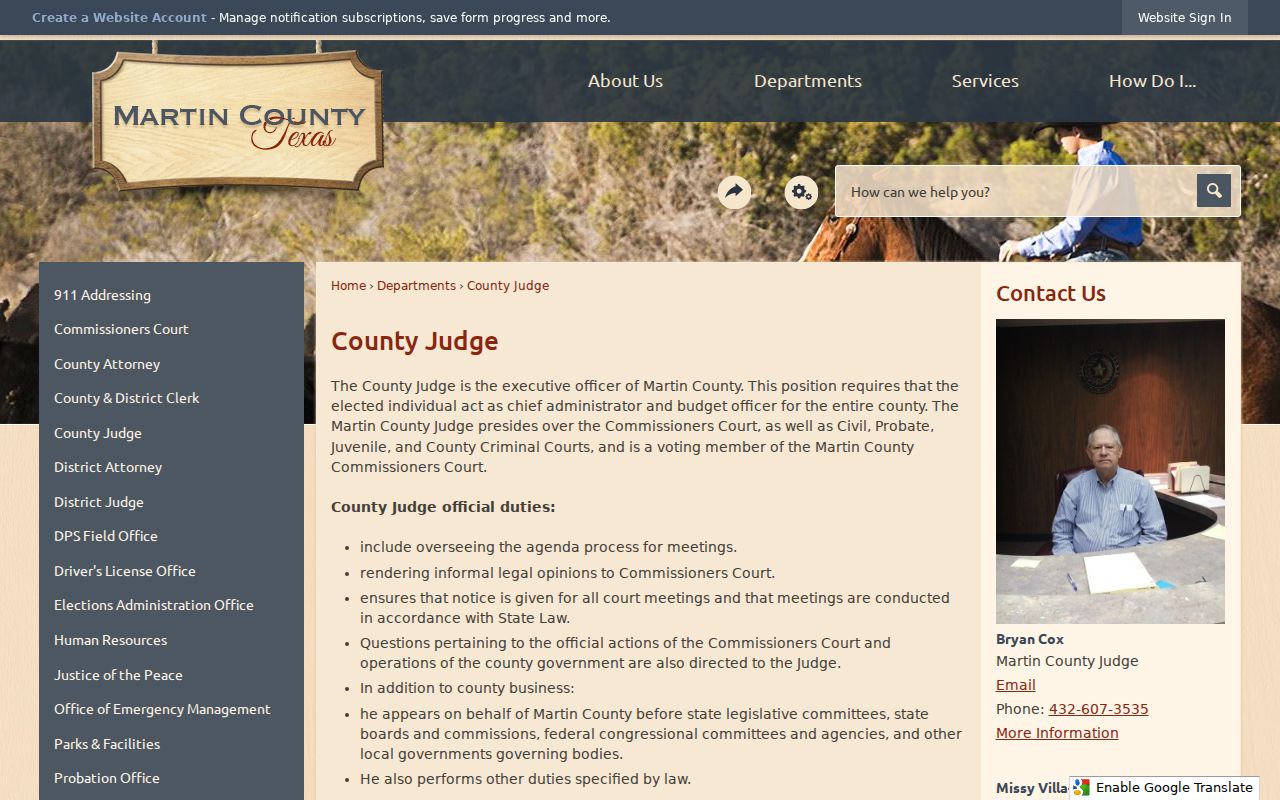
Arrest process in Martin County can start in more than one courtroom. The County Judge page describes the Constitutional County Court and its county-level duties. Justice courts take fine-only matters and some magistrate work. Stanton runs its own municipal court, and the 118th District Court handles Martin County's district cases. So the right office depends on the underlying case, not on where a person lives. Geography matters here too. The County & District Clerk is a combined office at the county seat that routes both county and district record questions, but the district-court directory lists the judge and district attorney in Big Spring while the clerk stays in Stanton. That split is exactly why you should use the exact court and case number when asking for a file. Check the county judge page for current county-court details, and rely on the court named on the case record for status.
District, justice, municipal, and federal cases each follow a separate route in Martin County. The issuing court remains the key source.
How Martin County Arrest Warrants Are Served
A judicial officer issues the warrant. An authorized peace officer executes it, and that officer may be a sheriff's deputy, a municipal police department, a constable, a marshal, or another agency depending on the warrant and the jurisdiction. The Martin County Sheriff's Office page posts general contact information and service-related resources, but the office publishes no public warrant roster and no dedicated warrant search. Before calling, figure out what you are really asking about. Issuance, service, custody, and the court docket are four different records, and different offices may hold each one. The current inmate roster can confirm a custody listing, but it says nothing about every outstanding court order still open in Martin County.
Martin County Sheriff’s Office
Dan Saunders Law Enforcement Center
3522 Interstate 20, Stanton, TX
432-756-3336
A Martin County Arrest Warrant Is Not a Bench Warrant or Summons
Arrest warrant, bench warrant, and summons are different routes into Martin County court or custody. The name on the paper matters, and a clerk can identify which entry the docket shows.
| Process | Purpose in plain language | First record route |
|---|---|---|
| Arrest warrant | Authorizes an arrest under a judicial process. | Issuing magistrate or court, then the serving agency for execution status. |
| Bench warrant | Responds to a missed or unmet court obligation. | The court that set the appearance or obligation. |
| Summons | Directs a person to respond or appear rather than itself being the same as an arrest warrant. | The court or agency named on the summons. |
A failed online lookup cannot tell you which of those applies in Martin County. Ask the court for its actual record description.
County and District Arrest-Warrant Records Route Differently
Martin County misdemeanor matters route through the Constitutional County Court, while felony matters go to the district court. The County Attorney's official description covers misdemeanor criminal and contested traffic work; the district attorney handles the felonies. The County & District Clerk serves as the combined contact for both county and district records. One caution, though. A prosecutor's office cannot replace the court as the authority on warrant status. Match your request to the paper in hand. If it names the 118th District Court, use the clerk's Stanton contact for the records route and the district-court directory for the court's Big Spring contacts. If it names county court, ask the county clerk how to reach that docket. Never send a case-specific request to a Martin County office just because it happens to be close by.
Arrest Warrant vs Summons vs Bench Warrant
The document you are holding, or the one a search turns up, matters less than what the court actually ordered. A Martin County summons simply tells you to appear on a set date, and following its instructions with proof of any filing keeps the matter calm. A bench warrant is different. It follows a missed obligation to the court. An arrest warrant rests on the legal basis a statute lays out. These papers are not interchangeable, and similar words in an online record do not make them so. When you call, ask the clerk to identify the exact order and its case number. Then, if a warrant may exist, talk with a lawyer about how to approach the issuing court before you act on your own.
What to Do If There Is a Martin County Arrest Warrant for You
Start with the basics. Get the issuing court and the case number before anything else. A licensed attorney can then help you decide whether to contact the court directly, arrange a voluntary appearance, ask about bond, or pursue another remedy. Martin County publishes no current bond schedule, no universal surrender checklist, and no recall form, so treat an old fee sheet or a third-party service with caution. Current instructions come from the court itself. Whatever the outcome, ask which record proves it, whether that is a payment receipt, a signed order, an updated docket, or a release document. If you reach the sheriff instead, say clearly whether you need routing, service information, or a custody record. Only the proper court can confirm its own later judicial action.
Do not guess at the next step: Confirm the court and process, then speak with a lawyer before deciding how to respond to a possible warrant.
The Martin County overview summarizes the local record routes and access limits.
Martin County Arrest-Warrant Papers May Be Restricted
Not every arrest-warrant paper in Martin County is open to the public. Texas Rules of Judicial Administration Rule 12 treats some arrest- and search-warrant material as special, and law-enforcement exceptions plus juvenile confidentiality can limit release further. Texas Family Code Section 58.010 restricts records for specified child-arrest warrants along with the supporting complaints or affidavits. So a public docket entry may show far less than the investigative file beneath it. If you want a record that exists, send a focused request. Identify whether a court or an agency holds it. For judicial records, follow Rule 12; for agency-held information, take the Texas Public Information Act route and ask how to appeal or narrow a denial.
Texas access references:
Texas Rule of Judicial Administration 12 sets the court-record access framework.
Government Code Chapter 552 covers agency records subject to statutory exceptions.
Family Code Chapter 58 addresses juvenile-record confidentiality.