
Bench Warrants in Martin County
Nobody publishes a single Martin County bench warrant list. A bench warrant is the tool a judge uses when someone misses a court date or ignores a court order, and its details live on that court's docket. The JP offices and Stanton Municipal Court each keep separate files. The sheriff's inmate roster will not answer the question. Start with the court named on your citation or notice. A city or JP case has its own clerk, calendar, and payment path. County and district cases run elsewhere. Confirm the right court in Martin County before you ask about a reset, a payment, or a recall.
Martin County Bench Process Depends on the Issuing Court
Martin County splits its courts into several routes. The justice courts take fine-only cases and magistrate work. The County & District Clerk runs one combined office for county and district records. The county judge's office handles county-court functions. The 118th District Court serves Martin County at the district level. Stanton Municipal Court takes its own city citations. All of them share a county seat and one sheriff's service area, but a warrant question still starts with the court that set the obligation. Ask which court issued it, what case number it used, and whether the docket shows a warrant, a capias, or another order, because that answer points to the office that can explain next steps.
How a Bench Warrant Is Issued
A judge or magistrate acts through the case itself. Texas procedure treats arrest warrants and lower-court process for municipal and justice-court cases as different things. A missed setting can trigger an order. So can a failure to comply with court terms. What the record actually says depends on the docket, not on the notice sitting in your mailbox. An unanswered letter alone proves nothing. Call the clerk in Martin County and ask whether the file shows a missed appearance, a later setting, a capias, or a warrant, along with the date on each entry. The clerk explains the record route and payment steps. For advice on how to respond, that is a licensed lawyer's job, and no clerk in Martin County can fill it.
A Missed Setting and a Capias Pro Fine Are Different Martin County Records
Texas lower-court practice uses two similar papers. One is a capias. The other is a capias pro fine, which enforces a fine after the applicable court process and is not interchangeable with every bench warrant or arrest warrant. The paper and the docket control the description. Start with the court type. Fine-only matters in Martin County sit with a JP precinct or with Stanton Municipal Court. A missed district or county-court appearance belongs to the clerk or court named on the notice. If a Martin County office uses a term you do not recognize, ask for the order in writing. Never guess at a payment or an appearance.
Bench Warrant vs Arrest Warrant
Both are court process with different roots. Use this plain-language comparison as a starting point; the issuing court in Martin County can identify the actual process in a specific case.
| Point | Bench warrant | Arrest warrant |
|---|---|---|
| Typical trigger | A court obligation was missed or not met. | A judge or magistrate finds the legal basis for arrest process. |
| Record source | The court with the scheduled appearance or underlying case. | The issuing court and agency involved in the investigation or service. |
| What to ask | Which setting or order led to the current entry? | Which court issued it, and what public information can be confirmed? |
| Resolution route | Ask the court about reset, payment, appearance, or recall steps. | Ask a lawyer and the issuing court about safe, case-specific next steps. |
JP Precincts Matter for a Martin County Bench Warrant
Martin County runs four JP precincts with only two judges. Precincts 1 and 3 share one. Precincts 2 and 4 share the other. Both offices sit at 301 N. St. Peter Street in Stanton, with separate phone numbers listed for the two precinct groups. Check the precinct on your citation first. That one detail can save a wrong-desk handoff. For jurisdiction questions and current contact details, check the county's JP page before contacting the office about a citation or a missed setting.
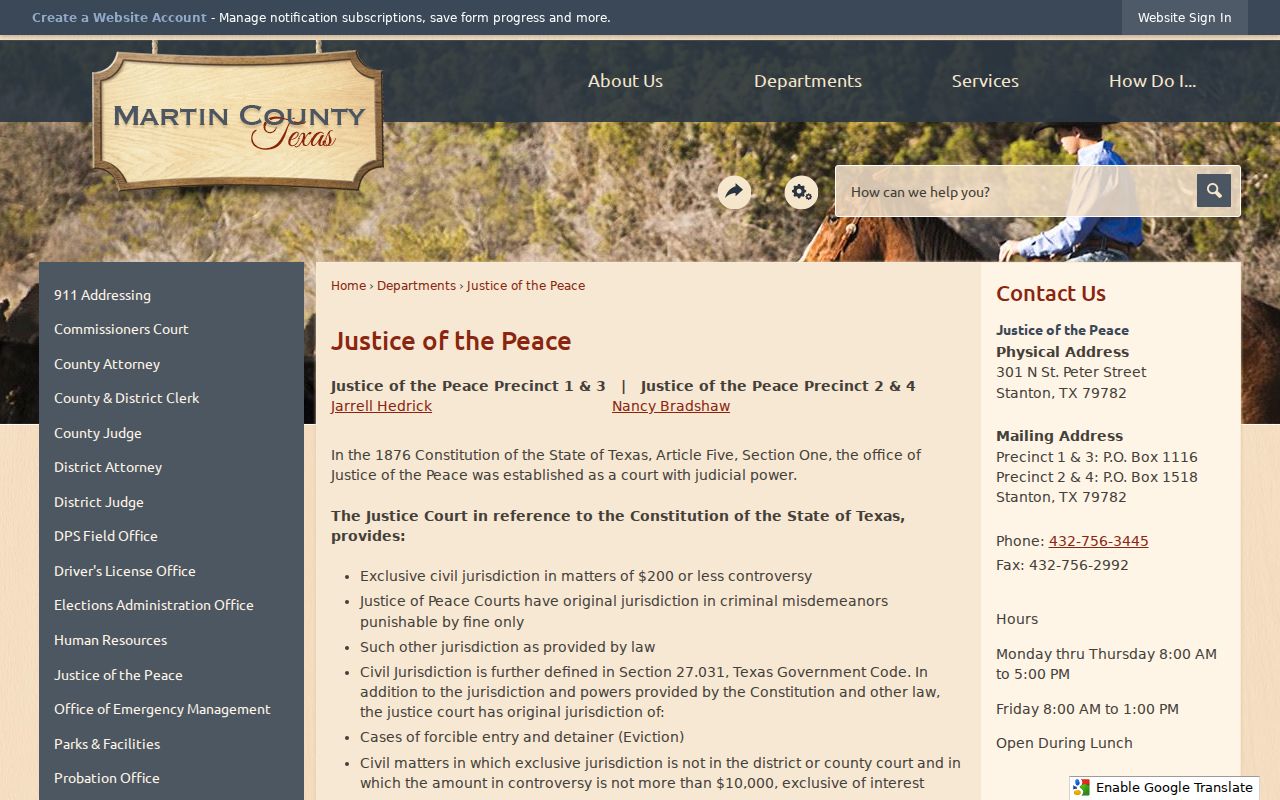
Use the court named on the notice. A JP office may not own the case. The JP staff directory lists the current office route, so review the official staff listing when a Martin County precinct handoff is unclear.
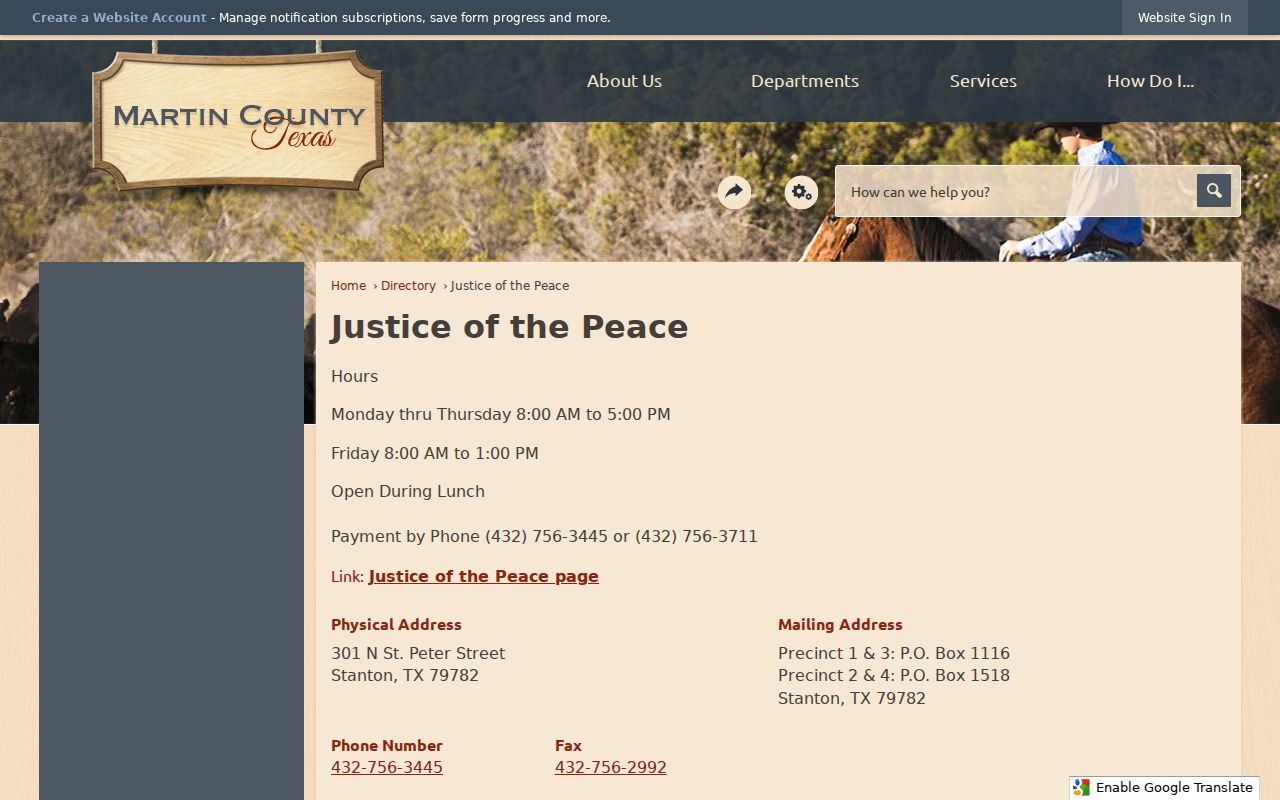
Match the paper’s precinct to the right JP office before sending a case-specific request.
How to Resolve a Martin County Bench Warrant
Martin County publishes no countywide bond schedule, recall form, surrender checklist, or walk-in resolution instructions. Every question goes to the issuing court. Ask what the court will accept. Ask whether a hearing or reset is needed and how it records a recall or payment. If you plan to appear in person or post bond, talk to a licensed Texas attorney about your own case first. Keep the cause number, payment receipt, court order, and written confirmation together in one place. A general sheriff contact can route a question, but only the issuing court can say whether its docket reflects the latest action. Written confirmation is your proof.
Before paying or appearing: Confirm the issuing court and the exact process first. Ask a lawyer about your options, then follow the court’s current written instructions.
What to Ask Before Resolving a Martin County Bench Warrant
Call with a short list of questions. Precision helps the clerk find what exists. Ask whether the matter is a citation, a missed setting, a judgment, a capias, a capias pro fine, or another warrant type, and which case number and court apply. Ask if a payment or appearance is authorized. Get the confirming document named too. If a portal comes up, ask whether it accepts payments on your case and whether paying alone changes the court's process. The Stanton GovRec route is for citation payment, not warrant status or recall. Keep your receipt. Then request a docket entry or written recall confirmation from the Martin County court. That paper closes the loop.
| Case identifier | Provide the citation or cause number from the court paper. |
|---|---|
| Process name | Ask the clerk to identify the court’s exact entry. |
| Next action | Confirm hearing, reset, payment, bond, or attorney requirements. |
| Proof | Ask what written receipt, docket entry, or order reflects completion. |
Which Martin County Court Issued It
Which court issued the paper decides where you go. Lower-court warrants usually stay with the municipal or justice court that issued them. County-court misdemeanors go through the county court. District matters belong to the 118th District Court and the combined clerk. Federal cases are separate. A Martin County record naming Stanton Municipal Court should start with that clerk. One naming a JP means matching the precinct. For county or district matters, follow the combined clerk's routing. A sheriff may serve or route process, but that does not make the sheriff's office the only place to check docket status. The County & District Clerk page explains the combined record function. For a broader route map, see the Martin County warrant overview.
Martin County Court and Warrant Records Have Separate Access Rules
Court records and agency records play by different rules. Texas court records fall under Rule 12 of the Rules of Judicial Administration. Agency-held records use the Texas Public Information Act. Arrest- and search-warrant materials can carry special restrictions. Juvenile records get extra protection. Even so, an office can often confirm that a Martin County case is filed without releasing every supporting document behind it. Ask in writing, and name the court, the case number, and the record type you want. If the answer is a denial or a narrowed release, ask which rule or exception applies and whether a separate court-record process exists.
Texas references:
Code of Criminal Procedure Chapter 45A covers procedure for municipal and justice-court criminal matters, including lower-court process.
Rule 12 provides the Texas judicial-record access framework.
Government Code Chapter 552 applies to public information held by governmental bodies, subject to exceptions.